Here's a Sneak Peek of The Table of Contents

Hey Friend,
I want to share with you the table of content for my ultimate starter guide (which is dropping tomorrow).
Why?
Because it may surprise you!
But before that, let me tell you my origin story.
Maybe I'm getting a little bit nostalgic before the launch at 11:00 am P.T. tomorrow, but whatever, hear me out.
When I first read How To Take Smart Notes By Sonke Ahrens, I was so excited. I knew there was something special there. I knew there was some magic in its free-flowing approach to writing and managing ideas.
But, I also struggled pretty hard following its guidance to building my own. And as I talked with others about this, something became clear. Ahrens' version is a bit different than the version it's based on, Niklas Luhmann's version.
Why does this matter?
Well, Niklas Luhmann was the one that wrote 70 books and hundreds of articles in 40 years. So, I'll have whatever he's having, please!
So, I took the next step. I started looking into details about Luhmann's zettelkasten. Wouldn't you know it, it was pretty easy to find.
Luhmann wrote a paper, Communicating with Slip Boxes. He advocated for using a zettelkasten when approaching research and writing. And, his estate digitized his entire zettelkasten online!
Bingo!
Well, there's a catch (maybe two). It's in German, and the English translation is pretty hard to read.
I had to read it 50 times over a few months while practicing it before I fully got it.
This is the reason why I don't just point people to it, and say have fun.
That is why this starter guide exists.
Its structure is actually based on Luhmann's paper! I've just distilled it down to the first principles he argued for.
Here's what it looks like:
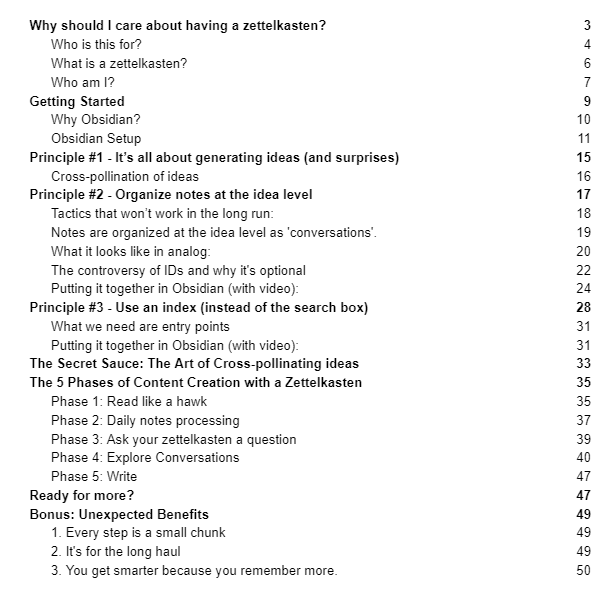
There are 3 parts:
Part One: Why and How to get started
I explain in a nutshell what a zettelkasten is and how it can be helpful to you. I'll also show you how to set up Obsidian so you can follow along.
Part two: 3 First Principles (and a secret sauce)
Here, we go through the exact arguments that Luhmann made, but in a way that's easier to understand. We'll also start to build it out in Obsidian with a couple of short video demonstrations.
Part three: 5 phases of content creation with a zettelkasten
In this last section, you'll get a glimpse of how a zettelkasten is used to generate ideas for writing.
And that's it!
Are you surprised? You'll be getting an in-depth look at a digital zettelkasten that's faithful to Luhmann's.
I sure am excited to see this in the hands of as many people as possible, so you all can experience the transformation that I had.
Cheers,
King
P.S. Remember you'll get a surprise gift if you like and comment on (and retweet if you're really awesome) if you're one of the first 20 people to do so! I'll remind you again by email tomorrow!
Interested!
I am interested. Hope I will learn a few new tricks.